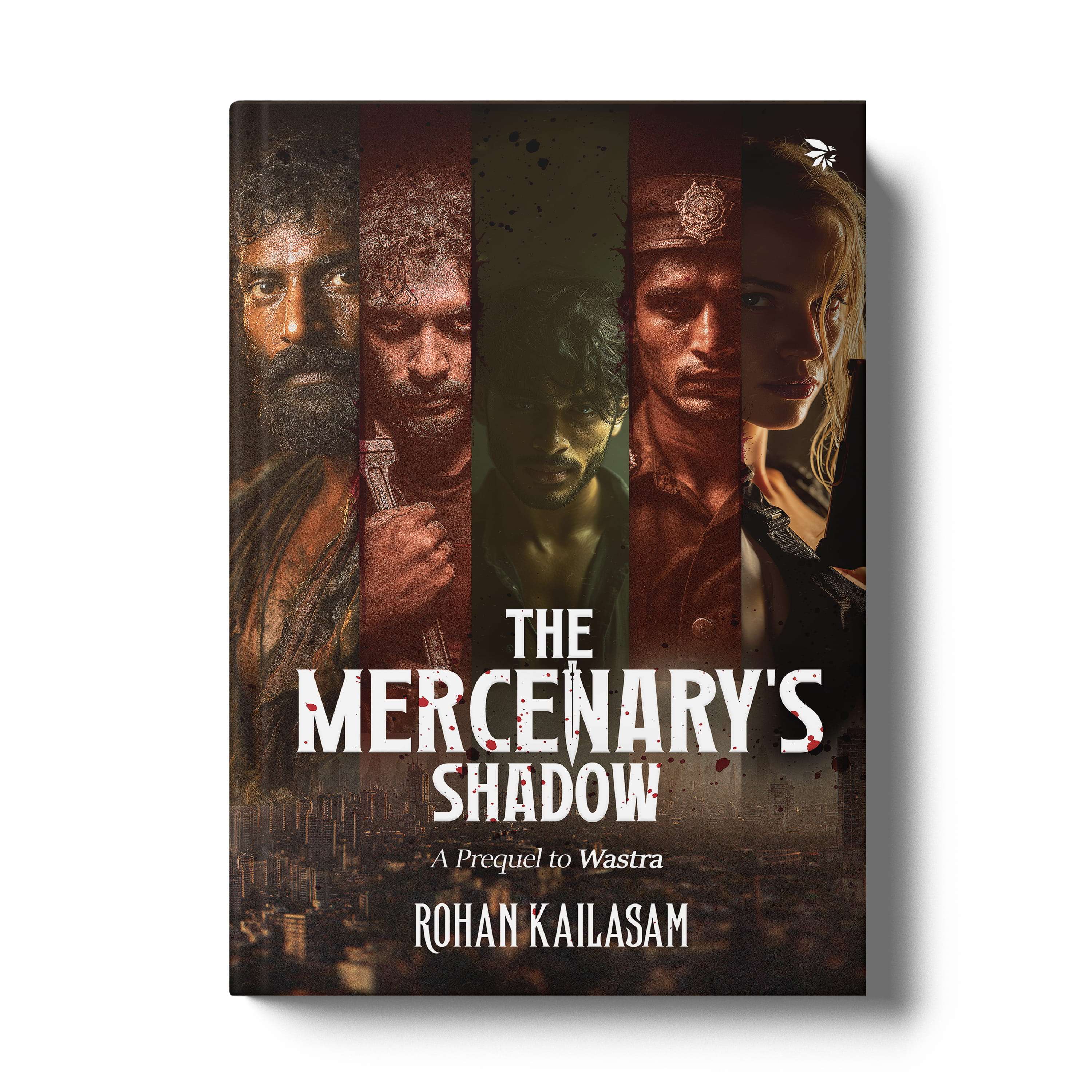
Violence rarely announces itself with spectacle. Sometimes, it waits quietly in the corner of a room, in the mind of a man who has learned to live with it. In The Mercenary’s Shadow, published with Nu Voice Press- an imprint of Hubhawks & exclusively distributed by Penguin Random House India, Rohan Kailasam writes from that uneasy silence, tracing a life shaped not by a single turning point, but by a slow, inevitable descent.
Billed as a crime-espionage thriller inspired by real events, the novel stretches far beyond the familiar lanes of Mumbai. It begins in Colaba, in the uneasy calm of Bombay’s underbelly, before spilling outward into the fractured landscapes of Sri Lanka’s insurgency, African mercenary conflicts, and covert operations in the Middle East. The scale is global, but the story remains intensely personal, anchored in the psyche of its central figure.
Arjun is not introduced as a legend. He becomes one. Once a promising tennis player navigating the rhythms of a coastal neighbourhood, he is gradually pulled into a world where survival depends on instinct and brutality. Over time, he sheds one identity after another, until he is known only in whispers as “The Rooh,” a presence more feared than seen. “He was born wrong. Born bad. Born with a blood moon in his eyes,” the novel observes, not as justification, but as quiet recognition.
What makes Arjun compelling is not just his capacity for violence, but his awareness of it. He exists in two worlds at once: at times a commercial pilot moving through controlled airspace, at others a mercenary operating in moral freefall. This duality shapes the novel’s emotional core, where memory and action are constantly at odds. Love, too, enters this equation not as redemption, but as complication, something that both anchors and destabilises him.
Running parallel to Arjun’s story is the unsettling presence of “The Plumber,” a serial killer whose methods are as methodical as they are disturbing. Where Arjun’s violence is shaped by conflict and circumstance, the Plumber’s is rooted in a warped sense of purpose, a belief in cleansing through brutality. The tension between the two is less about confrontation and more about contrast: two men navigating the same city, driven by entirely different compulsions, yet arriving at similar ends.
Kailasam’s own trajectory adds a layer of texture to the narrative. A commercial pilot who has spent years in transit, he wrote much of his earlier work mid-flight, suspended between geographies. That sense of movement finds its way into the book, where borders blur and allegiances shift with disquieting ease. The result is a story that feels less constructed and more observed, as though pieced together from fragments of lived experience.
There are echoes here of sprawling crime narratives like Sacred Games and the moral ambiguity of John le Carré’s espionage, but The Mercenary’s Shadow resists easy comparison. It is less interested in spectacle than in consequence, less in heroism than in what remains after it.
“At that moment, they weren’t the predators. They were the prey.” The line arrives early, but lingers long after. Because in Kailasam’s world, the distinction never quite holds. And in the making of a legend, something irretrievable is always left behind.
The Mercenary’s Shadow is out everywhere. Grab your copy today!