VADODARA: It rarely announces itself. A weakening in the wall of the aorta — the body's largest artery — can grow quietly for years, causing no pain, until the moment it doesn't. That gap between how ordinary it feels and how dangerous it can become is what makes an aortic aneurysm one of the more underdiagnosed conditions vascular specialists at Aadicura Superspeciality Hospital encounter.
“Most patients have no idea they are carrying one until it is picked up incidentally, on a scan done for something else entirely,” said Dr. Sumit Kapadia, Senior Vascular & Endovascular Surgeon. “By the time symptoms appear, the risk has usually already climbed.”
An aneurysm forms when part of the aortic wall weakens and bulges outward under the pressure of blood flow — not unlike a balloon stretching at its thinnest point. It can occur in the chest (thoracic) or abdomen (abdominal aortic aneurysm, or AAA). “What makes this condition tricky is precisely that it doesn't hurt while it's forming,” said Dr. Vijay Thakore, Senior Vascular & Endovascular Surgeon. “The patient feels completely normal until it has grown large enough to become dangerous.” The larger it grows, the greater the risk of rupture — a medical emergency causing sudden, life-threatening internal bleeding.
“In our OPD, the pattern is fairly consistent — long-standing hypertension, a history of smoking, and hardening of the arteries show up again and again in patients we eventually diagnose,” said Dr. Hiten Patel, Vascular & Endovascular Surgeon. Advancing age, high cholesterol, family history and certain inherited connective-tissue disorders add further risk, he said.
Small aneurysms are typically silent. When symptoms do surface, warning signs include persistent or sudden severe pain in the abdomen, chest or back; a pulsating, heartbeat-like sensation in the abdomen; and dizziness, fainting or a rapid pulse. “Sudden, severe pain — especially with fainting, breathing difficulty or a drop in blood pressure — is not something to wait out,” said Dr. Kushan Nanavati, Vascular & Endovascular Surgeon. “That combination can mean a rupture or dissection, and it needs emergency care immediately.”
A diagnosis is not, by itself, a call for immediate surgery. Treatment is individualised by the aneurysm's location, size, growth rate and the patient's risk profile. Smaller aneurysms are often managed through regular monitoring — ultrasound, CT or MRI — alongside tighter blood pressure and cholesterol control; quitting smoking is repeatedly flagged as one of the most consequential steps a patient can take.
“When we do need to intervene, the choice isn't one-size-fits-all,” said Dr. Parth Joshi, Vascular & Endovascular Surgeon. “Some patients are better suited to open surgical repair, others to an endovascular procedure using a stent graft, which is less invasive and often means a quicker recovery.”
Because the condition can remain undetected for years, doctors say the decision to screen shouldn't wait for symptoms — particularly for those who are older, smoke, live with hypertension, or have a family history of the condition. “It may be silent, but it can be deadly,” Dr. Kapadia said. “Know your risk, get screened when it's advised, and don't wait for pain to tell you something is wrong.”
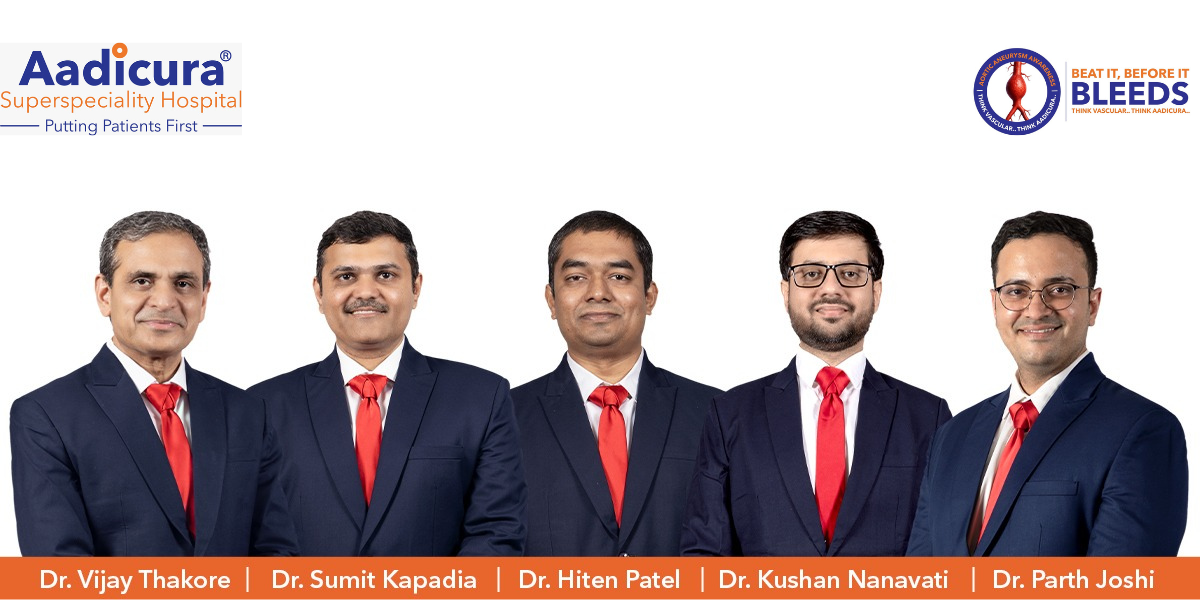
Dr. Sumit Kapadia. Dr. Vijay Thakore, Dr. Hiten Patel, Dr. Kushan Nanavati and Dr. Parth Joshi are Vascular & Endovascular Surgeons at the Aadicura Superspeciality Hospital, Vadodara
https://aadicura.com/speciality/vascular-endovascular-surgery/